
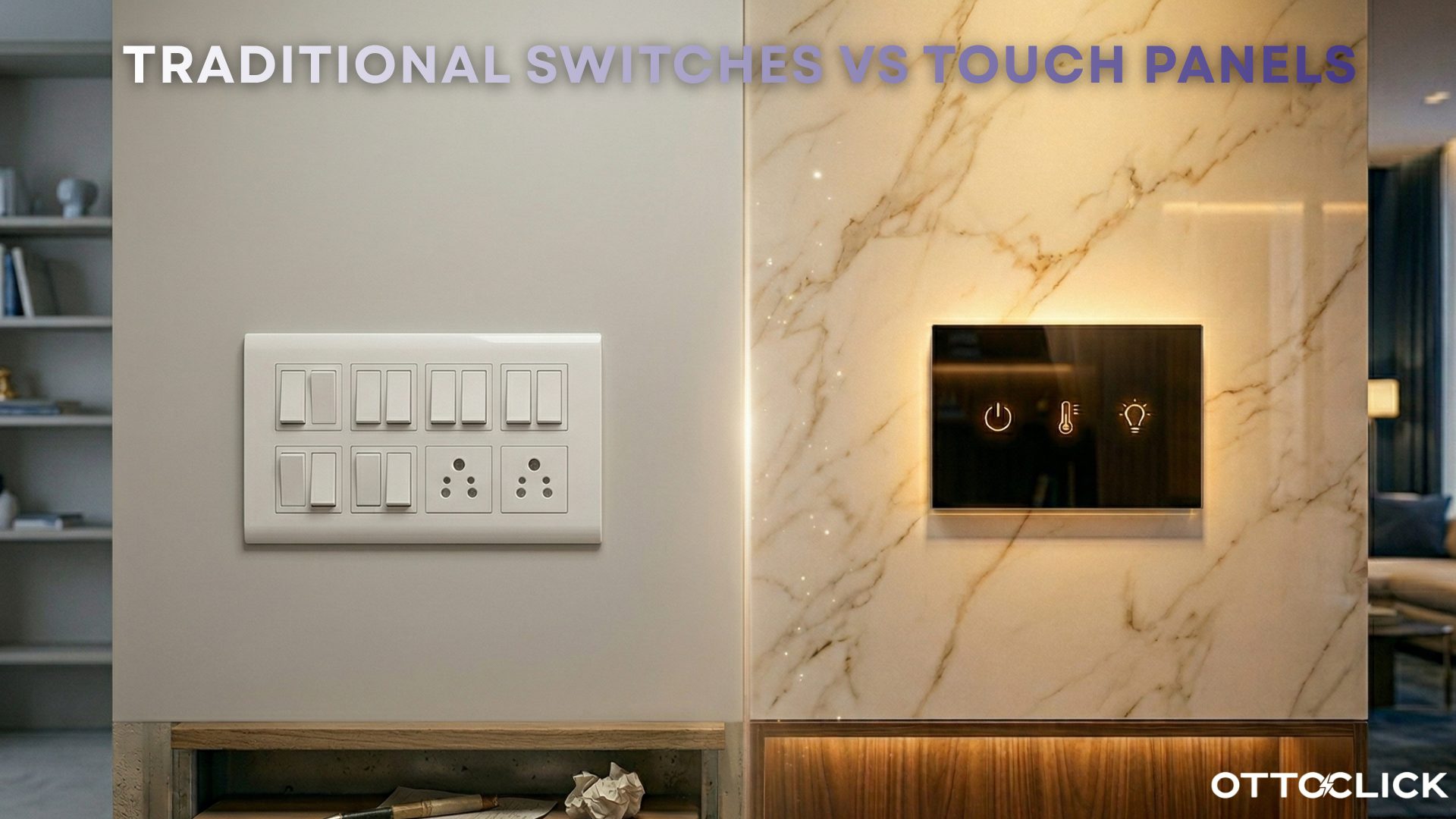
When designing a modern home, one of the most overlooked yet impactful decisions is the type of switches you install.
Most homeowners still default to traditional switchboards. However, with evolving lifestyle expectations, touch panels are rapidly becoming the preferred choice in premium homes.
The question is no longer about cost. It is about experience, aesthetics, and long-term value.
Understanding the Difference
Before making a decision, it is important to understand how touch panels and traditional switches differ.
Traditional Switches
Mechanical switches that control individual lights or appliances manually. Each function requires a separate switch, often leading to cluttered switchboards.
Touch Panels
Glass-based digital panels that allow multiple controls from a single interface. They integrate with smart home systems and enable centralized control.
The Visual Impact: First Impression Matters
In modern interiors, design consistency plays a crucial role.
Traditional switchboards often disrupt the overall aesthetic. Multiple buttons, uneven layouts, and plastic finishes can reduce the premium feel of a space.
Touch panels, on the other hand, offer :
- Minimalist glass finish
- Backlit controls
- Clean and uniform design
They blend seamlessly with luxury interiors, enhancing the overall look of the home.
Functionality: Beyond Basic Control
Traditional switches are limited to on/off functionality.
Touch panels transform how you interact with your home.
Multiple Controls in One Panel
Instead of multiple switches, a single panel can control lights, fans, curtains, and more.
Scene-Based Automation
Set predefined scenes such as:
- Evening mode
- Movie mode
- Night mode
With a single touch, multiple actions can be triggered simultaneously.
Integration with Smart Systems
Touch panels can connect with :
- Mobile apps
- Voice assistants
- Security systems
This creates a fully connected home environment.
Convenience: Everyday Living Simplified
Daily convenience is one of the biggest advantages of touch panels.
With traditional switches:
- You need to manually operate each switch
- Control is limited to physical presence
With touch panels:
- Entire rooms can be controlled from one point
- Access is available through mobile apps
- Voice commands can replace manual effort
This level of convenience significantly improves day-to-day living.
Space Optimization and Clean Layouts
In larger homes, especially 3BHK and 4BHK units, traditional switchboards can become bulky.
Multiple switches across rooms create visual clutter and confusion.
Touch panels reduce this complexity by :
- Consolidating controls
- Reducing wall clutter
- Creating a cleaner layout
This is particularly valuable in modern apartments and luxury homes.
Safety and Durability
Touch panels are designed with advanced technology that enhances safety.
They typically include:
- Smooth, sealed glass surfaces
- Reduced wear and tear compared to mechanical switches
- Better resistance to dust and moisture
Traditional switches, over time, may face issues such as loose connections or physical damage.
Cost Consideration: Short-Term vs Long-Term Value
One of the biggest reasons homeowners hesitate to upgrade is cost perception.
Traditional switches appear cheaper initially.
However, touch panels offer better long-term value due to:
- Integrated control, reducing the need for multiple devices
- Enhanced property value
- Future-ready technology
In premium homes, the investment in touch panels aligns with the overall value of the property.
Impact on Property Value
In competitive real estate markets, differentiation is key.
Homes equipped with touch panels and automation systems:
- Attract more attention
- Create a premium impression
- Stand out during resale or rental
This directly impacts both perceived and actual property value.
Ideal Choice for Modern Homeowners
Touch panels are particularly suitable for :
- Luxury apartments
- Newly constructed homes
- Renovation projects focused on modern design
- Homeowners looking for convenience and control
They are no longer limited to niche segments. Adoption is growing rapidly across modern households.
When Should You Upgrade
The best time to install touch panels is during :
- New home construction
- Interior design planning
- Electrical layout finalization
Early integration ensures better planning and seamless installation.
However, retrofit options are also available for existing homes.
The Future of Home Controls
The transition from traditional switches to touch panels is similar to the shift from basic phones to smartphones.
What once seemed like a luxury is quickly becoming a standard expectation.
In the coming years, homes without smart control systems may feel outdated, especially in premium segments.
Conclusion
Choosing between traditional switches and touch panels is not just a technical decision. It is a lifestyle decision.
Traditional switches serve a basic function.
Touch panels redefine how you interact with your home, offering better design, enhanced convenience, and a more premium experience.
For modern homeowners, this upgrade is becoming an essential part of future-ready living.
Explore Touch Panel Solutions
If you are planning a new home or upgrading your existing space, exploring touch panel solutions can significantly enhance both functionality and aesthetics.
Ottoclick offers premium touch panel and smart home automation solutions designed for modern living.
From design consultation to installation, the focus is on delivering a seamless and future-ready experience.
